Listen to this article
Browser text-to-speech
What is Hertz?
Middle C on a piano vibrates at 261.63 cycles per second. Your WiFi router oscillates at 2.4 billion cycles per second. A gamma ray from a nuclear reaction hits 10^20 cycles per second. All three are measured in the same unit: the hertz.
Hertz (Hz) is the SI unit of frequency -- one hertz equals one cycle per second. The math is dead simple: if a wave completes 100 cycles in one second, that is 100 Hz. A million cycles per second is 1 MHz. But the range of phenomena this single unit covers is staggering, stretching across more than 20 orders of magnitude from seismic rumbles to cosmic radiation.
The Legacy of Heinrich Hertz
The unit is named after Heinrich Rudolf Hertz (1857-1894), a German physicist who first proved the existence of electromagnetic waves in 1887. Working in his laboratory in Karlsruhe, Hertz built a spark-gap transmitter and receiver that demonstrated these invisible waves traveled at the speed of light and could be reflected, refracted, and polarized just like visible light.
Hertz died at 36, never knowing that his bench-top experiment would spawn radio, television, radar, and eventually every wireless technology we use today. The International Electrotechnical Commission adopted "hertz" as the unit of frequency in 1930.
Sound Frequencies: The Spectrum of Hearing
Sound waves are mechanical vibrations that travel through air (or other media) at frequencies we perceive as pitch. You can convert between common frequency units with our hertz to kilohertz tool.
The Range of Human Hearing
The typical human hearing range spans from 20 Hz to 20,000 Hz (20 kHz). This covers about ten octaves. However, this range varies significantly:
- Infants and children can often hear up to 20 kHz or slightly higher
- Adults typically lose high-frequency sensitivity with age, often maxing out around 15-17 kHz by middle age
- Frequencies below 20 Hz (infrasound) are felt more than heard, causing physical sensations rather than audible sound
- Frequencies above 20 kHz (ultrasound) are used in medical imaging and by animals like bats and dolphins
Bass Frequencies (20-250 Hz)
Bass frequencies provide the foundation and power in music:
- Sub-bass (20-60 Hz): The deep rumbles you feel in your chest at concerts or in movie theaters. Thunder, earthquakes, the lowest notes of a pipe organ.
- Bass (60-250 Hz): The punch of kick drums, the body of bass guitars, the weight of orchestral cellos and double basses.
These frequencies require large speakers and significant power to reproduce accurately, which is why dedicated subwoofers exist.
Midrange Frequencies (250-2,000 Hz)
The midrange is where most musical information lives:
- Low mids (250-500 Hz): Warmth and body of instruments, male vocal fundamentals
- Mids (500-2,000 Hz): Where human voices are most intelligible, guitar and piano fundamentals, snare drum punch
Treble Frequencies (2,000-20,000 Hz)
Treble frequencies provide clarity, detail, and sparkle:
- Upper mids (2-4 kHz): Presence and clarity in vocals, guitar bite, the attack of percussion
- Brilliance (4-6 kHz): Sibilance in speech, cymbal shimmer, string harmonics
- Air (6-20 kHz): The highest harmonics that give instruments their realistic quality, room ambience, hi-hat sizzle
Musical Note Frequencies
Music theory and physics intersect in the precise frequencies of musical notes. The international standard tuning reference is A4 = 440 Hz, adopted by ISO in 1955. When an orchestra tunes up, the oboe plays an A at 440 Hz, and everyone else adjusts.
Octave Relationships
Doubling a frequency takes you up exactly one octave:
- A2: 110 Hz
- A3: 220 Hz
- A4: 440 Hz (standard tuning reference)
- A5: 880 Hz
- A6: 1,760 Hz
This doubling creates the sense of two notes being "the same" but at different pitches. A standard piano spans from A0 (27.5 Hz) to C8 (4,186 Hz), covering over seven octaves.
Common Note Frequencies
Here are the frequencies for notes in the fourth octave (around middle C):
| Note | Frequency (Hz) |
|---|---|
| C4 (Middle C) | 261.63 |
| D4 | 293.66 |
| E4 | 329.63 |
| F4 | 349.23 |
| G4 | 392.00 |
| A4 | 440.00 |
| B4 | 493.88 |
Radio Frequencies: Wireless Communication
While sound waves need a medium like air, electromagnetic waves travel through vacuum. Radio frequencies form the backbone of modern wireless communication. For higher-frequency conversions, try our MHz to GHz converter.
AM Radio (530-1,710 kHz)
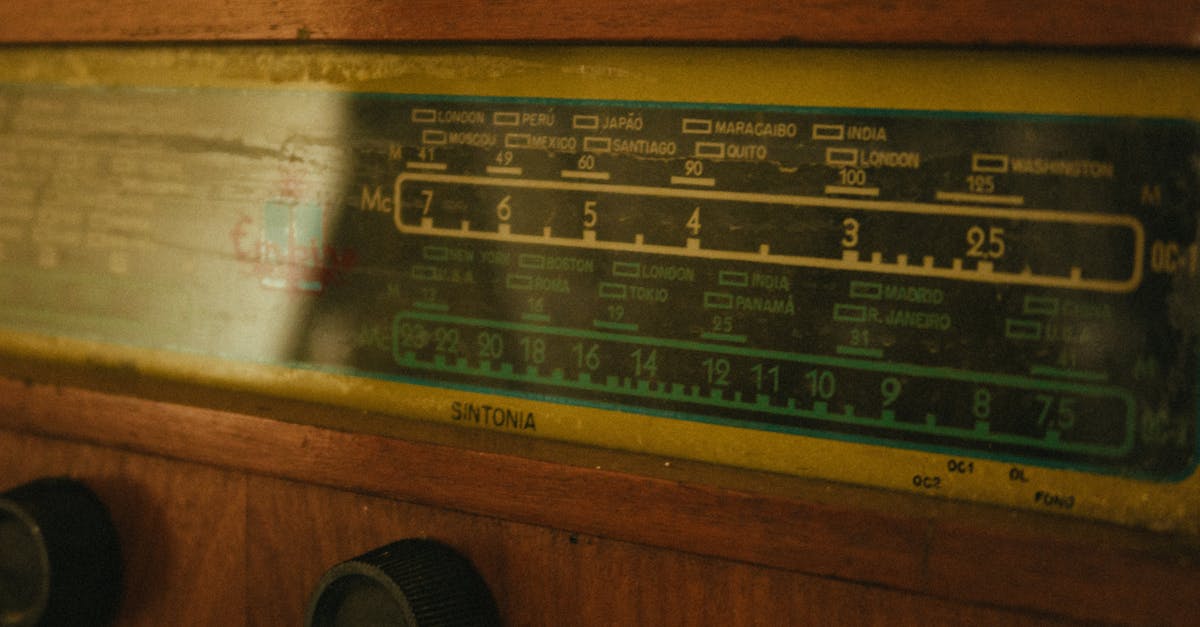
Amplitude Modulation (AM) radio operates in the medium frequency band. AM signals can travel long distances, especially at night when they bounce off the ionosphere. Audio quality tops out around 5 kHz -- fine for talk radio, rough for music.
FM Radio (88-108 MHz)
Frequency Modulation (FM) radio offers significantly better audio quality, with frequency response up to 15 kHz. FM signals are line-of-sight, so they do not bend around obstacles as well as AM, resulting in shorter range but much cleaner sound.
WiFi (2.4 GHz and 5 GHz)
Modern WiFi operates on two main frequency bands:
- 2.4 GHz: Better range, penetrates walls more effectively, but more prone to interference from microwaves and other devices
- 5 GHz: Higher bandwidth for faster speeds, but shorter range and weaker wall penetration
The choice between these bands is a classic range-versus-speed tradeoff.
5G Cellular (Sub-6 GHz and mmWave)
Fifth-generation cellular networks use multiple frequency bands:
- Sub-6 GHz (600 MHz to 6 GHz): Similar to 4G LTE, providing wide coverage with moderate speed improvements
- mmWave (24-100 GHz): Multi-gigabit speeds but very short range and poor obstacle penetration
The higher the frequency, the more data per second, but the shorter the effective range.
Frequency Prefixes: From Hz to GHz
Frequencies span an enormous range, so standard metric prefixes keep the numbers manageable:
| Prefix | Symbol | Value | Example |
|---|---|---|---|
| Hertz | Hz | 1 Hz | Bass drum (50 Hz) |
| Kilohertz | kHz | 1,000 Hz | AM radio (1,000 kHz) |
| Megahertz | MHz | 1,000,000 Hz | FM radio (100 MHz) |
| Gigahertz | GHz | 1,000,000,000 Hz | WiFi (2.4 GHz) |
| Terahertz | THz | 1,000,000,000,000 Hz | Far-infrared radiation |
Practical Applications of Frequency
Music Production and Audio Engineering
Audio engineers work with frequencies constantly:
- Equalization (EQ): Boosting or cutting specific frequency ranges to shape sound
- Filters: High-pass filters remove unwanted bass; low-pass filters kill harsh treble
- Synthesizers: Generate sounds by oscillating at specific frequencies
Electronics and Computing
Computer processors are rated by clock speed in GHz. A 3.5 GHz processor completes 3.5 billion clock cycles per second, governing how quickly it executes instructions.
Medical Applications
- Ultrasound imaging: Uses frequencies from 2-18 MHz to image internal structures
- Transcranial magnetic stimulation: Uses 1-50 Hz pulses for treating depression
- Hearing tests (audiometry): Measure sensitivity across the audible frequency range
Scientific Research
- Radio astronomy: Detects electromagnetic radiation from space across a wide frequency range
- Spectroscopy: Identifies materials by their characteristic absorption and emission frequencies
- Seismology: Analyzes earthquake waves, typically below 20 Hz
Converting Between Frequency Units
Converting between frequency units is straightforward:
- Hz to kHz: Divide by 1,000
- kHz to MHz: Divide by 1,000
- MHz to GHz: Divide by 1,000
For example, the standard WiFi frequency of 2,400,000,000 Hz equals 2,400,000 kHz, 2,400 MHz, or 2.4 GHz.
Conclusion
From the 27.5 Hz rumble of the lowest piano key to the 300 GHz upper limit of radio waves, hertz gives us a common language for oscillations across wildly different physical phenomena. Heinrich Hertz could not have predicted that his spark-gap experiment would lead to a world where billions of people carry pocket-sized radios operating at frequencies he never imagined -- but every one of those devices still measures its signals in the unit that bears his name.
See what our calculators can do for you
Ready to take control of your finances?
Explore our free financial calculators and tools to start making informed decisions today.
Explore Our Tools